


Technology
Microsoft Purview, Microsoft 365

Duration
Approximately 6 months | 2026
Part I — Business Context and Delivery Challenge
The Information Environment
The organization worked within an established Microsoft 365 environment, where sensitive information moved through everyday collaboration and business processes. Protecting that information meant understanding more than where a document lived. Its sensitivity depended on who used it, why it was shared and what restrictions the business could reasonably operate under.
That is the tension behind many information-protection initiatives: a technical control may be available long before there is agreement on how it should behave in practice.
The Protection Mandate
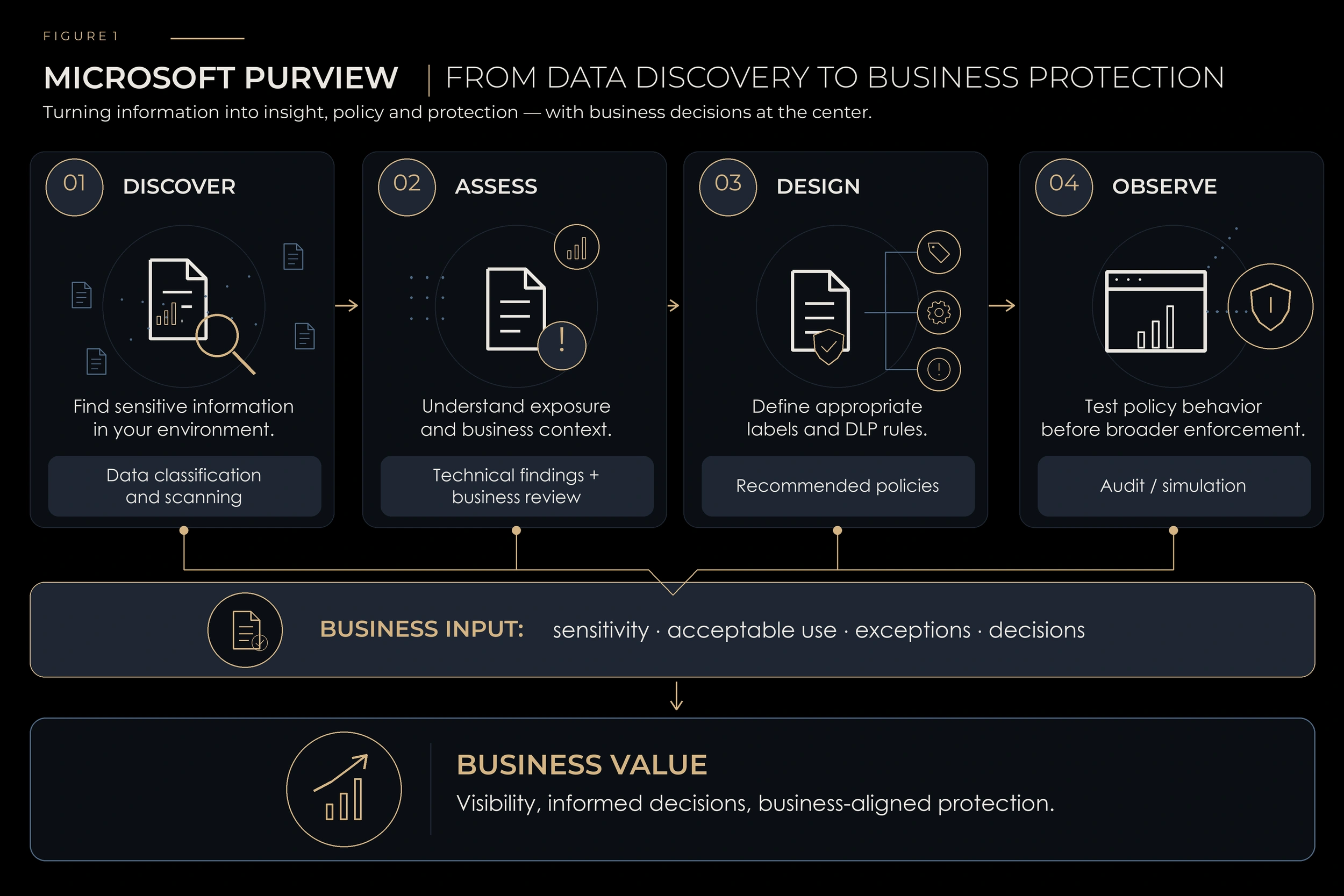
The assignment was to develop and implement an information-protection framework using Microsoft Purview. Discovery and scanning of identified information sources helped the specialists examine sensitive-information patterns and potential exposure, while the technical team developed recommended classifications and policy controls. Sensitivity labels and Data Loss Prevention (DLP) were central to the work.
Purview provides mechanisms to identify information, apply labels and configure policies that monitor or restrict how data is handled. But findings are not, by themselves, business decisions. A proposed protection still has to be evaluated against legitimate work, acceptable sharing practices and operational exceptions. The objective was not simply to switch on restrictions; it was to establish controls the organization could understand, refine and ultimately govern.
Where Technical Findings Meet Business Decisions
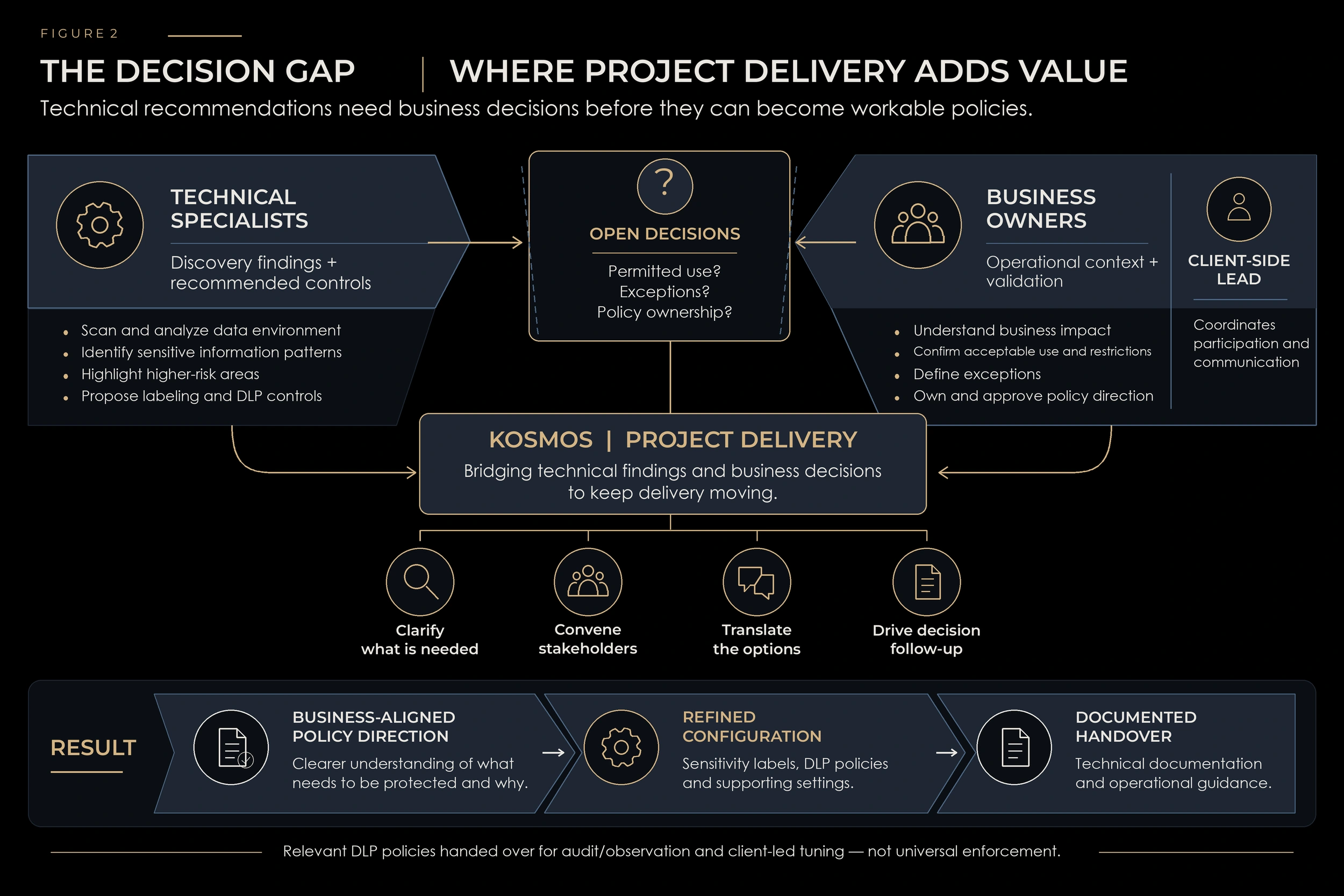
This was where the project’s most consequential dependency appeared. Technical specialists could explain what the environment revealed and recommend ways to protect information. The client-side lead could coordinate access and project discussions. Yet choices about acceptable use, exceptions and policy ownership needed the involvement of the business functions affected by those controls.
Those functions were not always positioned to answer immediately. The question “Can we implement this rule?” is technical. “Should this rule apply to our work, and under which conditions?” asks people to weigh operational consequences that are rarely settled by a configuration screen.
The engagement therefore needed more than an outstanding-decisions list. It needed structured support for informed decision-making across the business.
Part II — Project Delivery: Resolving the Decision Gap
A Dependency That Technical Work Could Not Resolve
Technical discovery and preparation continued while input from business stakeholders was being arranged. Interviews and questionnaires with functions including Finance, Human Resources, Legal and contracts-related teams were important to the policy-refinement work. Stakeholder availability affected the sequence: some technical tasks could move forward, while business-specific choices could not be finalized without the relevant context.
A conventional status report could identify an outstanding interview or decision. It could not, on its own, make that decision easier for the person responsible. The delivery challenge was to make the next conversation purposeful: what finding needed interpretation, who could explain the operational reality, and what clarification would allow technical work to progress?
Helping Stakeholders Move From Questions to Decisions
Kosmos supported the client-side lead in organizing the engagement across business functions and the technical team. The contribution was not to replace business authority or to keep repeating that an answer was overdue. It was to make the dependency actionable: clarify the input required, bring the appropriate people into the discussion, surface the practical implications and connect the response with the next delivery activity.
This kind of facilitation changes the conversation. Instead of asking a department to approve an abstract DLP rule, the team can bring forward the information patterns observed, the protection being recommended and the possible effect on routine work. Business stakeholders can then explain legitimate use, identify exceptions and refine the intended policy direction.
As stakeholder discussions progressed, their findings informed the technical team’s refinement of the controls. The client remained the owner of organizational policy choices; delivery leadership helped create the conditions for those choices to be considered and translated into project work.
Translating Business Direction Into Controls
The exchange worked in both directions. Technical findings and recommendations were put into business terms; business requirements, in turn, helped shape labels, publishing policies, DLP rules and sensitive-information definitions. The technical specialists performed the configuration. Kosmos supported cross-functional delivery by keeping discussions, unresolved inputs and technical follow-through connected.
Figure 2 captures the difference between tracking a dependency and helping resolve it. The value did not come from taking a policy decision away from the client. It came from connecting the evidence, the people and the decision-making process so that progress was possible.
Keeping the Delivery Path Moving
While business participation and policy refinement were under way, the project continued to require planning, stakeholder coordination, scope awareness and regular communication. Kosmos maintained visibility over work that could proceed, decisions still needed and the implications for the remaining delivery sequence.
In the final delivery phase, attention turned to policy work, design-review coordination, documentation and closeout preparation. The engagement concluded with a client closeout session and the transfer of technical design and working materials through the shared repository.
Part III — Business-Aligned Protection and Outcome
From Technical Configuration to Business Ownership
The handover was deliberately more than a list of settings. It gave the organization configured protection capabilities, design references and a clearer understanding of the policy choices those capabilities were intended to support. Cross-functional participation helped bring the protection approach closer to how the business actually used information.
Relevant policies remained in audit or observation mode at closeout. This allowed the client to continue reviewing policy behavior, assessing exceptions and refining controls before making progressive enforcement decisions. Technical project completion and organization-wide enforcement were therefore distinct stages, with the latter remaining under client ownership.
The Outcome
The principal result was a more coherent, business-informed foundation for information protection: technical findings had been brought into conversation with the people responsible for information handling, and their context had informed the direction of the configured controls. The organization had greater clarity about the decisions behind its policies, not simply a new set of technical settings.
The documented engagement deliverables included:
Sensitivity labels and publishing policies configured in Microsoft Purview
Data Loss Prevention policies and sensitive-information types
Cross-functional interviews and requirements input supporting policy refinement
Technical design, configuration references and working materials
Documented project closeout and operational handover for client-led observation and future refinement
These outcomes establish a foundation for protection aligned with business needs. They do not imply that all controls were already enforcing restrictions, or that organization-wide adoption and security improvements had been independently measured.