

Technology
Ticketing, API, PM Platform, Business Portal

Duration
6 months | 2025
Part I — Business Context and Mandate
Client Environment
The work was undertaken for the internal technology organization of a company whose business units depended on it for systems support, enhancements and new technology initiatives. The technology environment covered several functional domains, while Sales, Operations, HR, Finance and other internal stakeholders needed a dependable interface for requesting work and understanding its progress.
The challenge extended beyond formal projects. Incoming work ranged from user issues and service requests to enhancements and new initiatives. Each needed an appropriate path, yet all competed for the same finite attention, capacity and funding.
The Mandate
Before the initiative, the journey from incoming request to completed work was not consistently governed. There was insufficient clarity about how requests should be assessed, how priorities were decided, when budget and resource approvals were needed, and how an issue should be distinguished from work requiring formal project initiation.
Limited status visibility amplified the problem. Employees and managers frequently asked technology staff for updates or escalated questions through different channels. Department leaders lacked a comprehensive view of the tickets and projects affecting their functions, making it difficult to align priorities or discuss competing commitments with a shared understanding of the pipeline.
The mandate was to establish a centralized PMO operating framework that could control the full lifecycle of internal technology work: intake, triage, assessment, prioritization, authorization, execution, communication and closure. Just as importantly, it needed to give business users and decision-makers appropriate visibility without forcing everyone into the PMO’s internal working process.
The Starting Point
The organization already owned a ticketing system and a project-management platform. Rather than introduce another tool, the work began by examining how those existing capabilities could support one managed process. The design also had to connect different technology functions with clear ownership and common governance, while keeping the experience straightforward for the departments requesting support.
The resulting operating model is presented through four interdependent components. Governance defined accountability and decision rights; execution connected intake with controlled delivery; visibility made progress accessible to different stakeholders; and enablement equipped people and tools to work within the new framework.
Part II — PMO Setup: Building the Operating System
PMO Governance Foundation
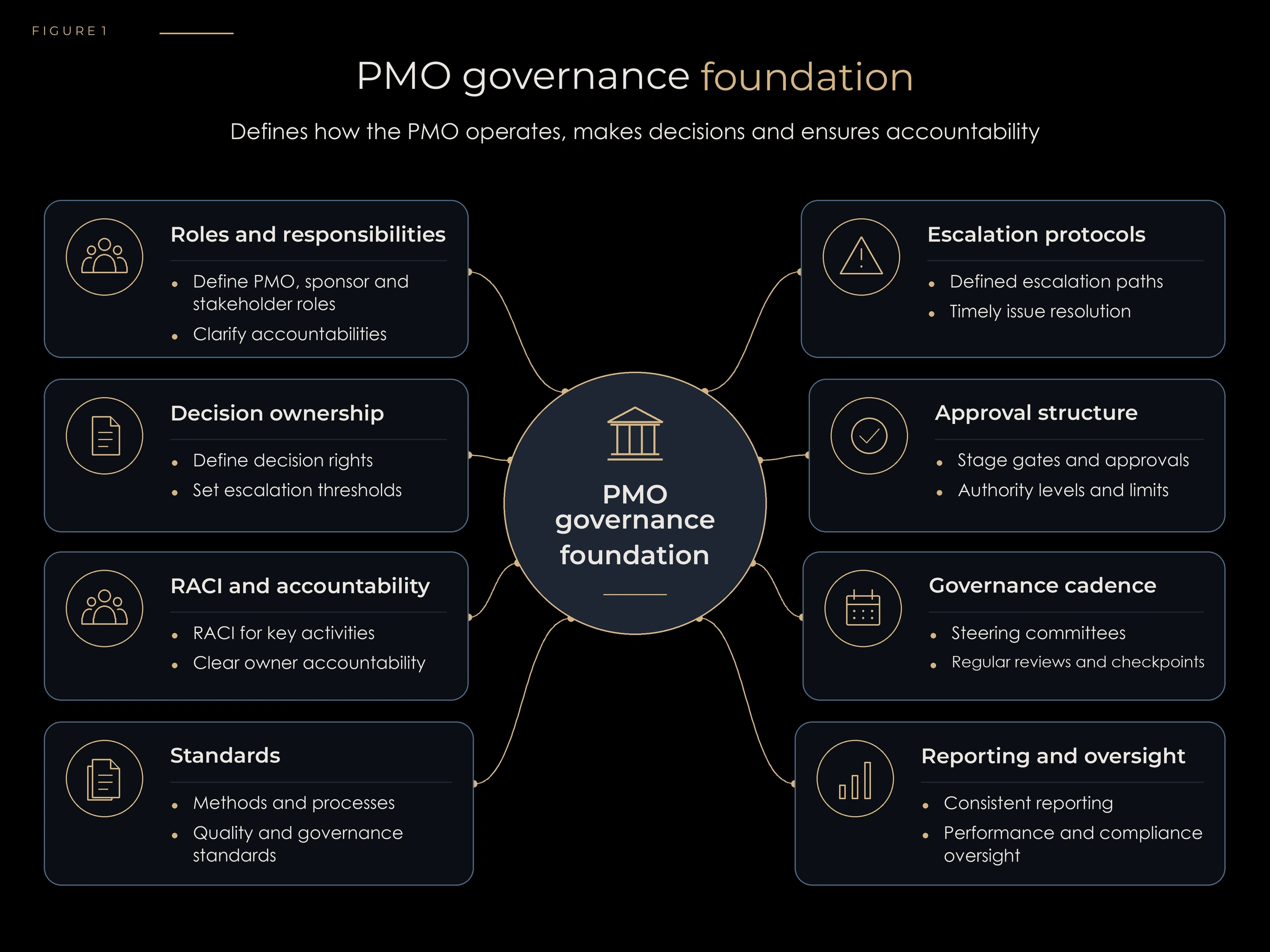
The first component established the PMO’s governing structure: what functions it was responsible for, who owned decisions, how roles interacted and which controls applied before work could proceed. An adapted TOGAF Architecture Development Method (ADM) approach helped organize business and technology responsibilities into a coherent target operating model, while PMO establishment practices translated that architecture into working governance.
The work included defined leadership and functional responsibilities, a role catalog, decision authority, escalation protocols and a RACI model covering 33 activities. The underlying design spanned five technology domains and ten office functions, but the PMO governance focus was not an organizational chart. It was the assignment of accountability for the work moving between those functions.
A PMO charter, playbook, operating standards and governance protocols established common expectations for assessment, approvals, handoffs and controlled delivery. These documents gave participants a shared reference for how the PMO was expected to function, rather than leaving key decisions to informal arrangements.
These elements established the decision structure on which the rest of the system depended: who was accountable, who could authorize work and how an exception would be escalated. Figure 1 brings those governance components together.
Request-to-Delivery Execution Model
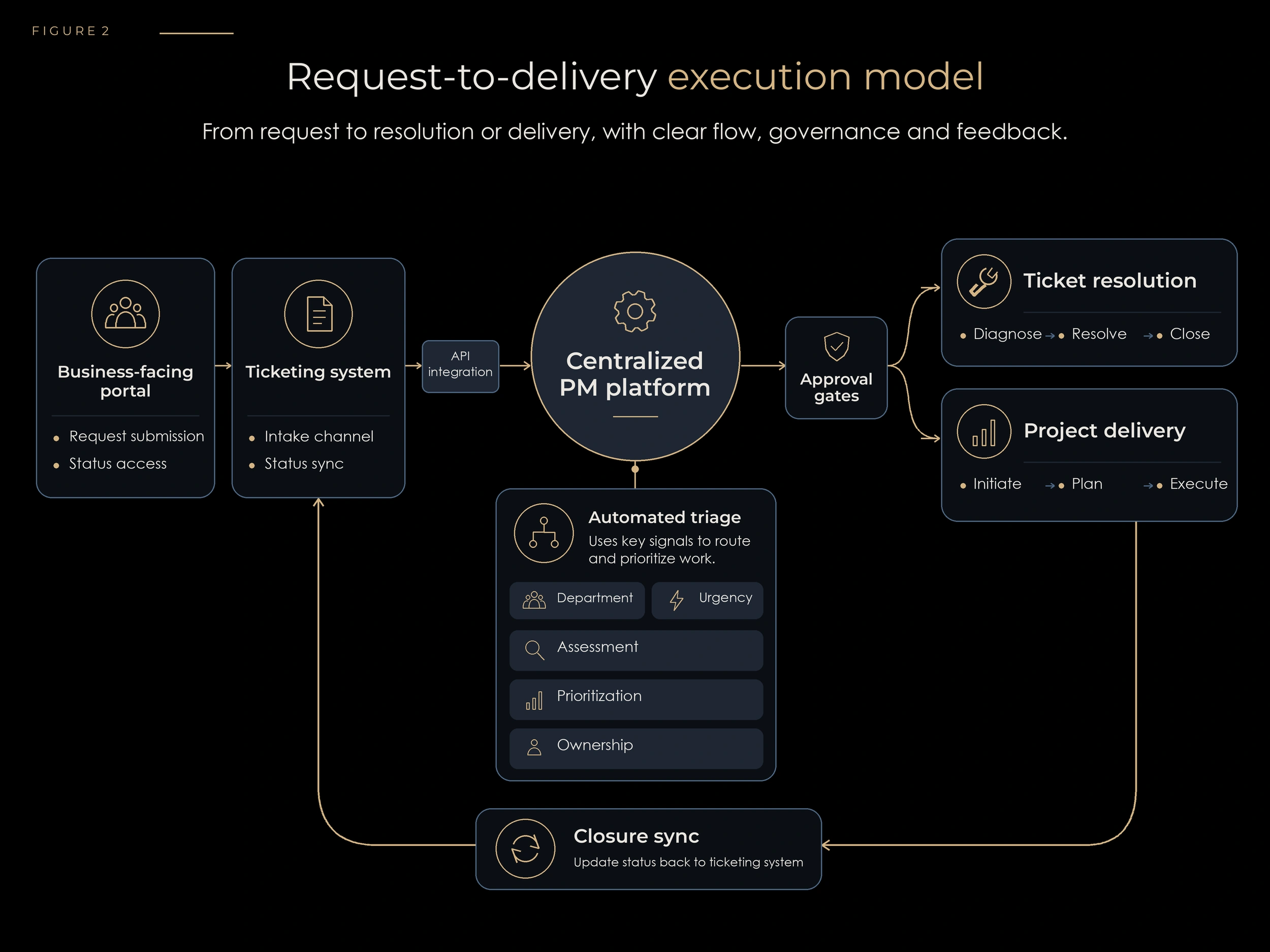
The governance rules needed a consistent path into day-to-day execution. The business-facing portal gave employees an entry point into the existing ticketing channel. An API connection then surfaced incoming tickets in the centralized project-management platform, where the PMO managed both service requests and project initiatives, not just work already classified as a project.
Initial triage inside the centralized PM platform was automated. Incoming items were classified or directed using signals such as the responsible department and urgency, after which the PMO could assess scope, priority, ownership, available resources and the appropriate execution route. Automation supported the first routing decision; it did not replace the judgment needed for prioritization, budgeting or authorization.
Some initiatives were subject to multi-level approval, including PMO and relevant business-unit decisions, before development could begin. Requests that could be resolved operationally continued through the ticket-resolution workflow. Work requiring substantial development or coordinated delivery moved into project initiation, planning, execution, monitoring and closure with the relevant project charter, stakeholder, timeline, communication and change controls.
Both routes remained managed in the centralized PM platform. For resolved tickets, a return signal synchronized status and closure with the ticketing system. Figure 2 illustrates this continuous flow from request entry and automated triage through approval gates to ticket resolution or project delivery.
Multi-Level Visibility Model
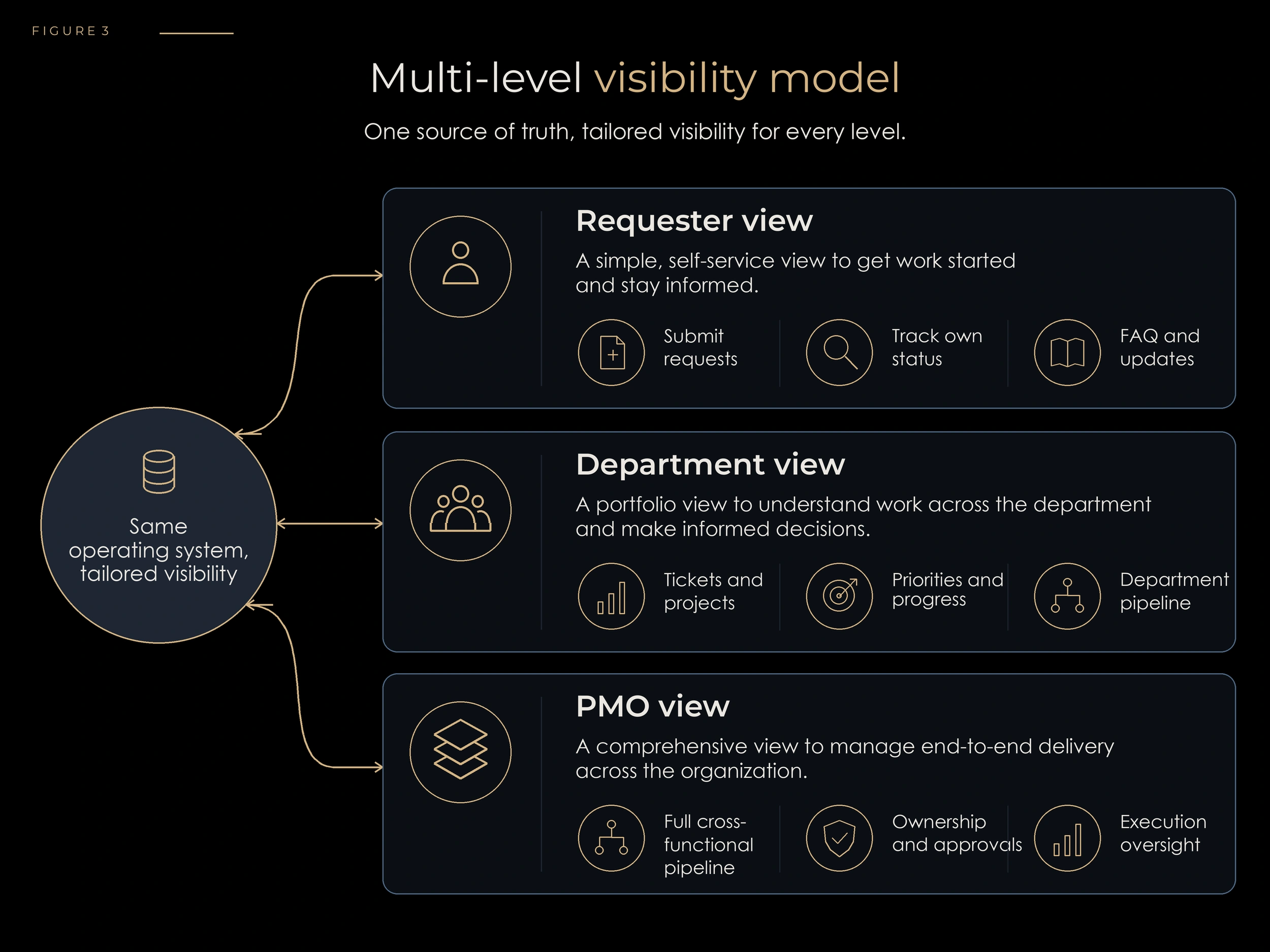
A centralized execution platform made it possible to address the original visibility gap. Rather than offer the same dashboard to everyone, the model distinguished three audiences and the decisions each needed to make from the information available.
For requesters, the business-facing portal provided submission, personal ticket status, FAQs and updates. It offered a clear alternative to chasing individual technology contacts for routine progress information.
Department leaders received a more granular pipeline view of the tickets and projects associated with their functions, including priorities and progress. This gave resource, sequencing and budget discussions a common picture of demand.
Within the PMO, the operational view brought together ownership, classification, approvals, active tickets, projects and execution status across departments. Figure 3 shows how these three levels of visibility were designed around the same managed work, without requiring every stakeholder to use the PMO’s internal workspace.
Operating Enablement
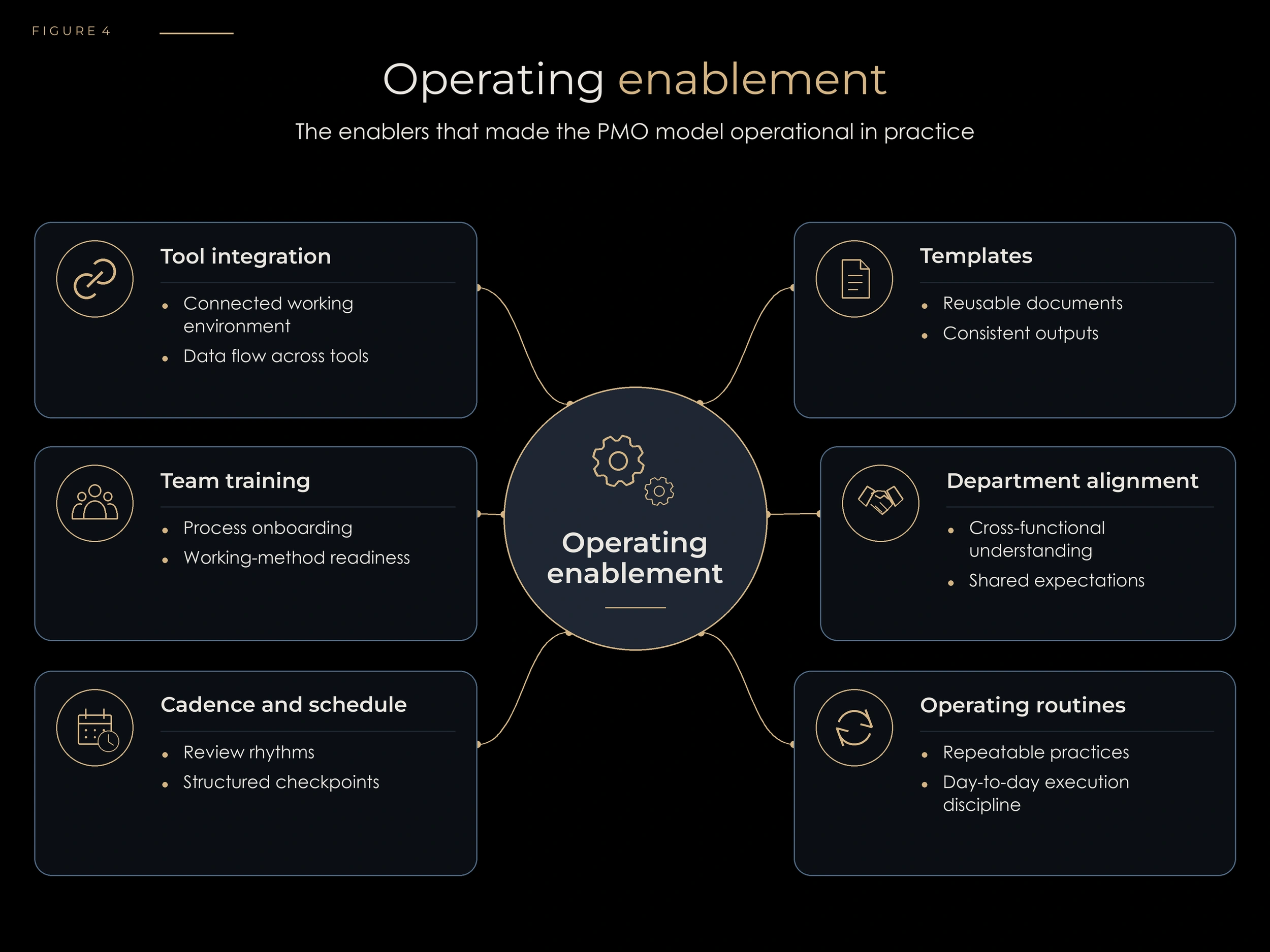
The fourth component addressed a different challenge: making the designed model usable. Governance, execution and visibility would remain fragmented unless the platforms were configured coherently, teams had practical guidance and business functions understood how to work with the PMO.
An assessment of existing tools supported a practical implementation approach without buying a separate PMO platform. The work also organized the project-management workspace into clearer portfolios, departmental structures, ownership fields and tracking views. Together with the API connection described in the execution model, this provided a usable foundation for the common operating process.
Reusable templates and operating materials were prepared to support consistent project records, communication and process execution. Internal training and working sessions helped PMO participants understand the playbook, responsibilities, working procedures and platform. Alignment discussions with Sales, Operations, HR, Finance and technology leaders clarified the intended business interface, priorities and approval expectations.
Regular operating cadences were established for internal coordination and engagement with functional representatives, covering pipeline, dependencies, priorities and decisions. Figure 4 groups these practical enablers—tools, templates, training, alignment and recurring routines that made the framework more than a collection of designed procedures.
Part III — Integrated Solution and Outcome
Centralized PMO Operating System
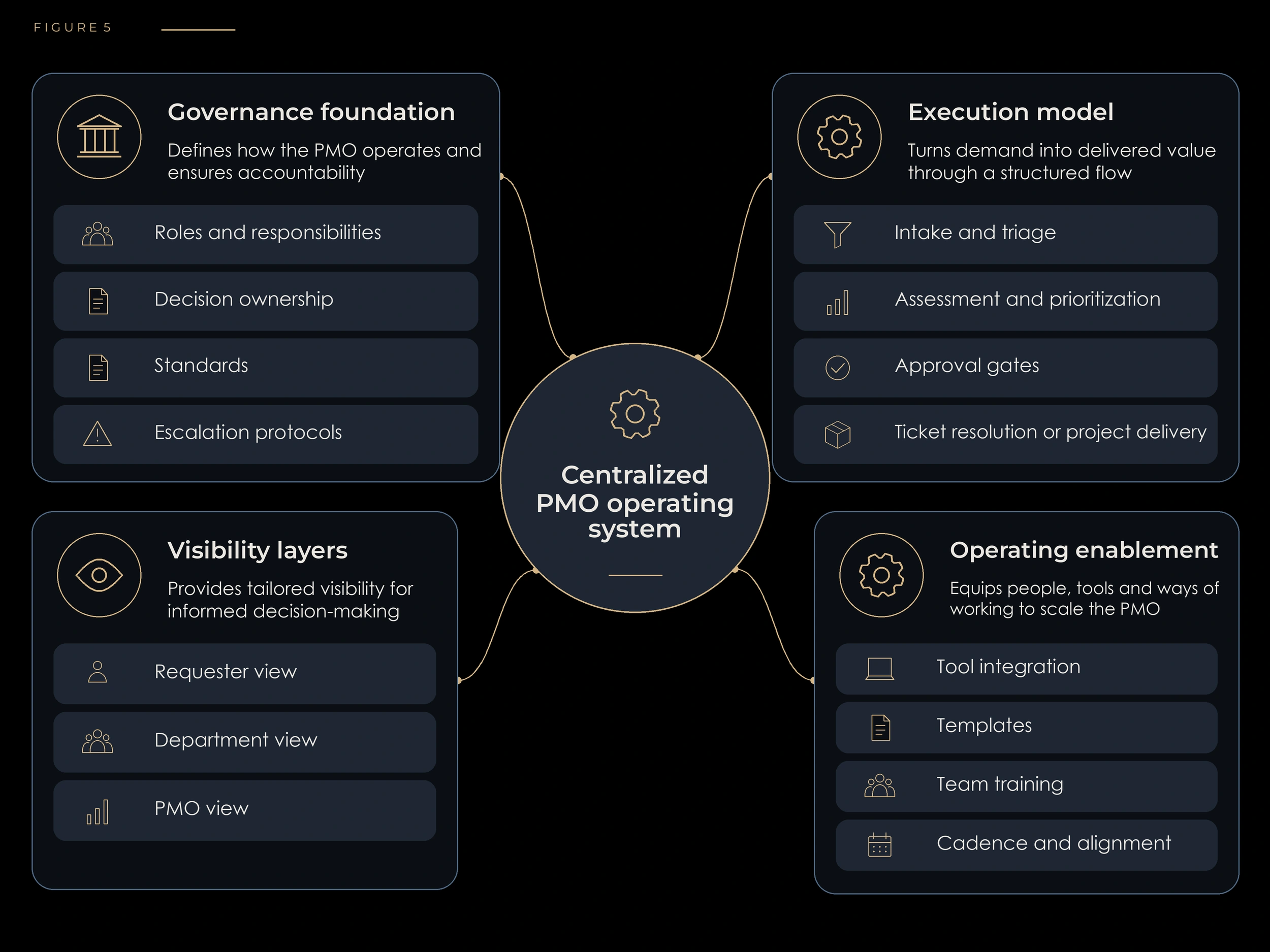
The four components were not independent deliverables. Governance defined the rules and decision owners; execution put those decisions into a managed workflow; visibility made work understandable to the relevant audiences; and enablement connected the tools, documentation, people and operating cadence required to use the framework consistently.
Consider one incoming business request under the designed model: it could enter through the portal, move through automated triage, be assessed and authorized within the PMO, follow either a resolution or project-delivery path, and appear in the appropriate status view. Figure 5 shows how the four modules support that single connected journey.
The Outcome
The six-month initiative delivered the following integrated set of operating-model components and enablement activities:
- PMO structure — functional model, leadership roles and clear responsibility boundaries
- Governance framework — decision authority, RACI, escalation protocols and approval structure
- Charter, playbook and standards — documented processes, operating rules and controls
- Request-to-delivery lifecycle — intake, automated triage, assessment, prioritization, approvals, ticket resolution and project management
- Existing-tools assessment — evaluation and selection of a practical approach using available platforms
- Integrated execution environment — API-connected ticketing and PM platforms, structured portfolios and synchronized ticket closure
- Business portal and multi-level visibility — requester status, departmental ticket/project pipelines and PMO oversight
- Stakeholder alignment — working discussions across business units and technology leadership
- Operating enablement — templates, internal training, recurring cadences and shared working practices
Together, these deliverables established the foundation of a centralized PMO: defined governance, connected workflows, structured execution, role-specific visibility and teams prepared to work within a common model. The six-month engagement produced both the framework and the supporting tools, procedures and enablement materials needed for operational use.